
Climate Justice
Living the SDGs in Kibera
From the world's largest informal settlement, see how the climate crisis lands first and hardest — and how Kibera responds.
Overview
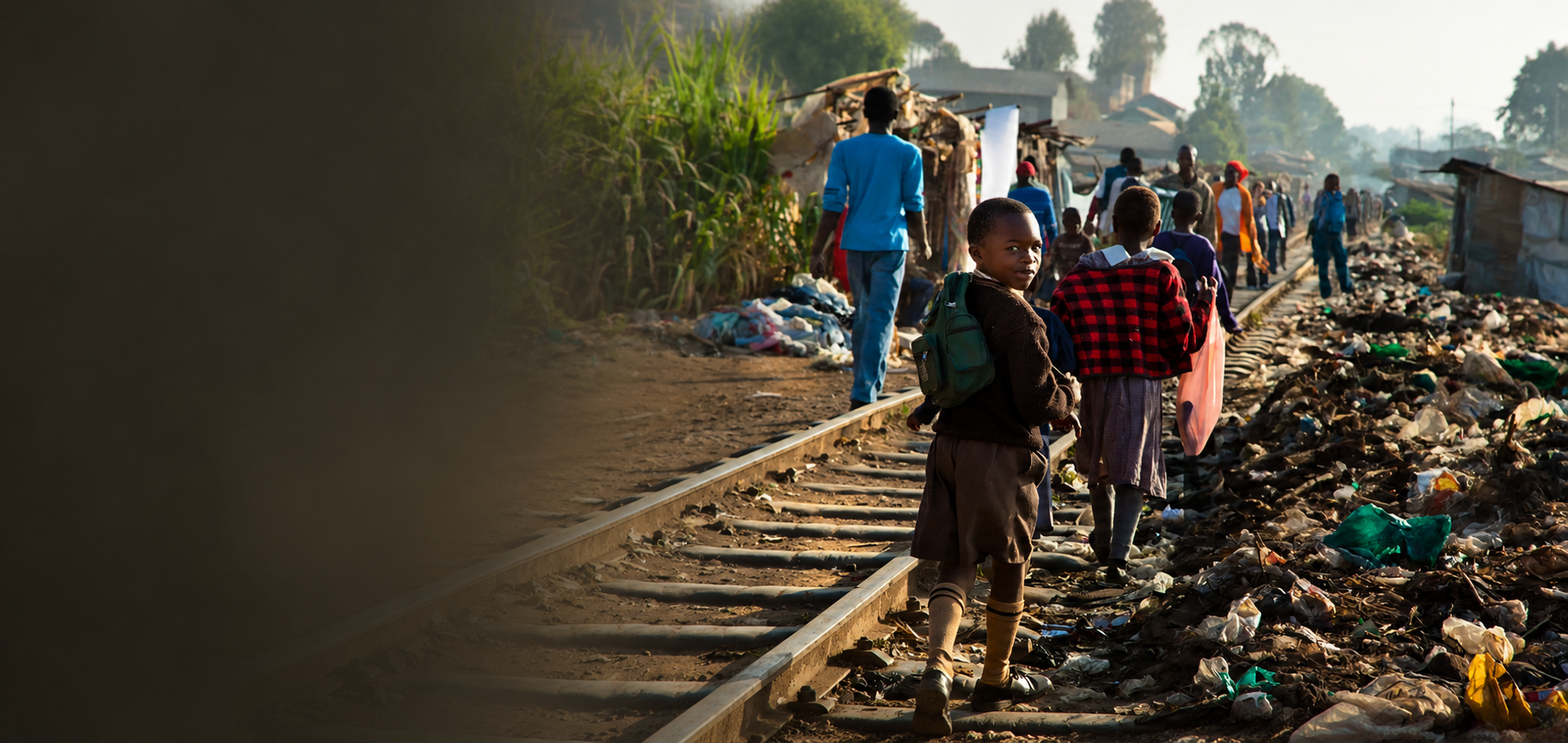
In this session, learners travel virtually and in real time to Kibera, Kenya — one of the largest informal settlements in the world, where more than 250,000 people live within a three-square-kilometre area. Guided live by a local community member, learners are not passive observers but active participants in a shared journey through daily life, community spaces, and lived realities where the Sustainable Development Goals are negotiated every day.
As the session unfolds, learners walk through Kibera's narrow pathways, visit homes, and encounter people whose lives bring global development challenges into sharp, human focus. They are welcomed into a typical household, seeing firsthand how families live within small, single-room spaces, how homes are constructed using metal roofs and mud walls, and how daily activities such as cooking, sleeping, and water storage take place without running water. These moments ground abstract discussions of housing, health, and inequality in real human experience.
Moving through the community, learners observe shared sanitation facilities, water collection points, and informal waste disposal areas. They learn how water pipelines pass through open drains, increasing contamination risks, and how limited infrastructure directly affects health, dignity, and opportunity. Alongside these challenges, learners also encounter community-led solutions — such as overhead water pipelines that demonstrate resilience, problem-solving, and local innovation.
Education and aspiration form a central part of the experience. Learners visit a community-run school and hear the story of how it was established to serve local children, gaining insight into both the possibilities and limitations of education within informal settlements. They also witness local entrepreneurship, creativity, and community spirit — from small food businesses to public art and shared cultural expression — offering a fuller, more balanced picture of life beyond hardship alone.
Throughout the session, learners actively engage using Globe From Home's SDG Mapping Canvas, identifying Sustainable Development Goals as they emerge in real time, distinguishing between systemic challenges and community-led solutions, and applying a climate lens to understand how climate change intensifies existing vulnerabilities. Climate change is framed not as a distant future threat, but as a present force — increasing heat inside metal-roof homes, worsening flooding, spreading contamination, and amplifying health risks.
This session is designed to be deeply thought-provoking and participatory. Through facilitated reflection and action-oriented follow-up, learners are encouraged to connect lived realities to global frameworks, develop systems thinking, and envision realistic, context-aware responses rooted in dignity, empathy, and local knowledge.
What you'll take away
- Walk through Kibera live with a local community guide and experience daily life firsthand
- Map the Sustainable Development Goals in real time using Globe From Home's SDG Mapping Canvas
- Distinguish between systemic challenges and community-led solutions on the ground
- Apply a climate lens to understand how climate change intensifies existing vulnerabilities
- Witness resilience, entrepreneurship and education emerging from within the community
- Develop systems thinking and envision context-aware responses rooted in dignity and empathy
How it works
This session is part of Globe From Home's Planetary Citizenship Program. This can be booked as a stand-alone masterclass or as part of the full programme. Once a date is confirmed, we send a private access link. Learners can join collectively from classrooms or individually on any mobile device.